

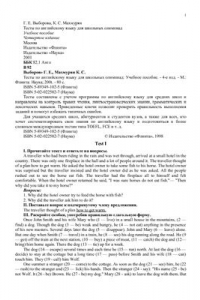
Тесты составлены с учетом программы по английскому языку для средних школ и направлены на контроль правил чтения, лингвострановедческих знаний, грамматических и лексических навыков. Приведенные ключи позволят проверить правильность выполнения заданий и помогут избежать типичных ошибок.
Для учащихся средних школ, абитуриентов и студентов вузов, а также для всех, кто хочет систематизировать свои знания по английскому языку и подготовиться к более сложным международным тестам типа TOEFL, FCE и т. д. Книга «Тесты по английскому языку для школьных олимпиад» авторов Галина Выборова, Каринэ Махмурян оценена посетителями КнигоГид, и её читательский рейтинг составил 8.00 из 10.Для бесплатного просмотра предоставляются: аннотация, публикация, отзывы, а также файлы для скачивания.
Описание книги
Тесты составлены с учетом программы по английскому языку для средних школ и направлены на контроль правил чтения, лингвострановедческих знании, грамматических и лексических навыков. Приведенные ключи позволят проверить правильность выполнения заданий и помогут избежать типичных ошибок.Для учащихся средних школ, абитуриентов и студентов вузов, а также для всех, кто хочет систематизировать свои знания по английскому языку и подготовиться к более сложным международным тестам типа TOEFL, FCE и т. д.4-е изд. — М.: Флинта: Наука; — 80 с. ISBN 5-89349-102-5 (Флинта) ISBN 5-02-022582-7 (Наука) Книга «Тесты по английскому языку для школьных олимпиад: Учебное пособие» авторов Каринэ Махмурян, Выборова Г.Е. оценена посетителями КнигоГид, и её читательский рейтинг составил 0.00 из 10.Для бесплатного просмотра предоставляются: аннотация, публикация, отзывы, а также файлы для скачивания.
Информация об издании
- Переводчики: не указаны
- Серия:
не указана - ISBN (EAN): не указаны
- Языки: не указаны
- Возрастное ограничение: не указано
- Год написания: не указан
Эта книга еще не добавлена в подборки
К ЭТОЙ КНИГЕ НЕ ДОБАВЛЕНЫ персонажи
КНИГА НЕ УПОМИНАЛАСЬ В БЛОГАХ

Test I
I. Прочитайте текст и ответьте на вопросы.
A traveller who had been riding in the rain and was wet through, arrived at a small hotel in the country. There was only one fireplace in the hall and a lot of people around it. The traveller thought of a plan how to get warm. He asked the hotel owner to take some fish to his horse. The hotel owner was surprised but the traveller insisted and the hotel owner did as he was asked. All the people rushed out to see the horse eat fish. The traveller had the fireplace all to himself and felt comfortable. When the hotel owner returned he said, «I was sure horses do not eat fish.»— «Then why did you take it to my horse?»
Вопросы:
1. Why did the hotel owner try to feed the horse with fish?
2. Why did the traveller ask him to do it?
II. Поставьте вопрос к подчеркнутому члену предложения.
The traveller thought of a plan how to get warm.
III. Раскройте скобки, употребив правильную глагольную форму.
Once John Smith and his wife Mary who (1 — live) in a small house in the mountains, (2 — find) a dog. Though the dog (3 — be) weak and hungry, he (4 — not eat) anything in the presence of his new masters. Several days later the dog (5 — disappear). John and Mary (6 — leave) alone. But one day when Smith (7 — travel) in a train, he (8 — see) his dog running along the road. He (9 — get) off the train at the next station, (10 — buy) a piece of meat, (11 — catch) the dog and (12— bring) him home again. There the dog (13 — tie) up for a week.
The dog (14— escape) several times and each time he (15— run) north. At last the dog (16 — decide) to stay at the cottage but a long time (17 — pass) before Smith and his wife (18 — can) touch him. They (19 — call) him Wolf.
One summer a stranger (20 — come) to the cottage. As soon as the dog (21 — see) him, he (22— rush) to the stranger and (23 — lick) his hands. Then the stranger (24 — say): «His name (25 — be) not Wolf. It (26 — be) Brown. He (27 — be) my dog.» Mary (28 — ask) to leave the dog with them. But the stranger (29 — refuse) and (30 — say) that the dog (31 — must) decide it himself. «I (32 — say) goodbye and (33 — go) away. If he (34 — want) to stay, let him stay.» For some time Wolf (35 — watch) the man go. Then he (36 — rush) after him and (37 — try) to stop him. Then the dog (38 — run) back to Smith and his wife (39 — try) to drag Smith after the stranger. He (40 – want) to be at the same time with the old and the new master. Finally the dog (41 — lie) down at the feet of Smith. Mary (42 — be) happy.
V. Переведите на английский язык.
1. Москва была основана Юрием Долгоруким.
2. Небо темное, может пойти дождь.
3. Мы не знали, что он собирается нас навестить.
4. Кто знает прогноз погоды на завтра?
5. Нам не пришлось долго ждать их.
VI. Выберите правильный ответ.
1. What’s the name of the most famous clock in Britain?
a) Big Albert, b) Big Stephen, c) Big Wren, d) Big Ben.
2. What’s tartan?
a) a dish, b) a pattern of the kilt, c) a bird, d) a dance.
3. Where is Glasgow situated?
a) in Scotland, b) in Wales, c) in England, d) in Northern Ireland.
4. What’s the name of the London underground?
a) Metro, b) Tube, c) Subway, d) Underground,
5. What is the nickname of the Liberal Party?
a) the Tories, b) the Whips, c) the Libs, d) the Whigs.
Олимпиада по английскому языку 4-6 классы 2022-2023 муниципальный этап
I (школьный) тур олимпиады по английскому языку 2011-2012 г.
Комплект заданий для 9 класса.
Раздел 1. Аудирование (10 минут)
Вы услышите текст о 20-х годах 20 века. Определите, какие из приведенных утверждений ( 1 – 7) соответствуют содержанию текста(1), какие не соответствуют(2), и о чём в тексте не сказано, то есть на основании текста нельзя дать ни положительного, ни отрицательного ответа(3). Обведите номер выбранного вами варианта ответа. Вы прослушаете текст дважды. Занесите ответы в бланк.
1. In the 1920’s life began to gain speed.
1) true 2) false 3) not stated
2. In the twenties jazz gave way to waltz (вальс).
3. Charleston was the most popular dance of the period.
4. They began to make sound films in the year of 1923.
5. The music played during movie shows helped to create the right atmosphere.
6. The first radio programmes were listened to with the help of a pair of headphones.
7. The first radios were big and rather costly.
8. The use of cars stimulated road building.
9. The early cars were not safe enough to be used in big cities.
10. Before the twenties American women could not vote like men did.
Раздел 2. Чтение (25 минут)
I. Установите соответствие заголовков A-G абзацам текста 1-6. Занесите свои ответы в бланк. Используйте каждую букву только один раз. В задании один заголовок лишний.
A Start strong E Talk to an expert
B Plan ahead F Take a break
C Eat for energy G Find the right place
D Just do it!
1. It’s possible to get your homework done even if you have a busy schedule – if you decide in advance what you have to do. On Sunday or Monday, jot down (записать) your activities for the upcoming week in a notebook and then include a time for home work for each day.
2. Forget about doing your homework in front of the TV. Find a quiet place that’s well-lit, where you can concentrate without getting distracted.
3. You won’t get any work done if you’re hungry. Your brain needs energy to work effectively! Drink plenty of water, and snack on some fruit or cookies to get more strength.
4. Begin with your best subject. Your success will give you a feeling of satisfaction that will help you deal with your weaker subjects later.
5. Take at least a five-minute break when you feel tired. The rest will re-energise you so you will be able to finish your work.
6. Homework is rarely an exciting thing to do. But it’s your top priority, and you have to get it done. Accepting this fact will help you deal with homework effectively.
II. Прочитайте текст и заполните пропуски 1-10 частями предложений A-K. Одна из частей в списке A-K — лишняя. Перенесите ответы в бланк.
A. finding a date G. tuxedos (смокинги)
B. rent a limousine H. the obligatory part
C. dress up in fancy dresses I. invitation card
D. a group affair J. a special occasion
E. to attend K. vintage clothing shops
F. a junior prom
Proms in the United States
At the end of school years there’s 1._______________ known as a ball, or a party, where everyone celebrates the end of the most important part of their life. In the USA it’s called a prom (from the word promenade). Sometimes it happens twice: at the end of school and after 2.________________ of one’s school years, that is the 9th form. This one in the USA is called 3.________________ .
Not all schools in America have an official junior prom. If you attend a small high school, there is only one prom and students from all grades are invited 4.______________. If you go to a larger high school, there is usually a senior prom that only graduating seniors and their guests are invited to, and a junior prom that underclassmen can attend.
Like the senior prom, girls 5._________________ and the guys usually wear suits or 6._______________. Prom is a fun reason to get dressed up, go all out, get your hair done, go out for a fancy meal, maybe even 7.________________ with some of your friends to celebrate in high style. Guys have it pretty when it comes to prom because they can always rent their clothes, but it doesn’t work that way for girls. They check out 8.______________ for a prom dress that’s completely different from anything anyone else is going to be wearing.
Probably the most nerve-wracking thing about junior prom, or any other school dance for that matter, is 9.________________. It is a tradition in the USA to go to a prom as a couple. If you are not attached to someone when prom time rolls around and you still want to attend, the best way is to try making junior prom 10.__________________. Then you can attend with a group of guy and girl friends, where there are multiple unattached people. This way everyone gets to enjoy the fun of the prom without the pressure of having to find a date.
Раздел 3. Грамматика и лексика (25 минут)
I.Прочитайте приведённый ниже текст. Преобразуйте слова, данные в скобках так, чтобы они грамматически соответствовали содержанию текста. Перенесите ответы в бланк.
New Seven Wonders of the World: the Great Wall of China
Just like a gigantic dragon, the Great Wall runs up and down deserts, mountains and grasslands for 6,700 kilometers from east to west of China. It is one of the 1 ________ (great) wonders of the world with more than 2,000 years of history.
The Great Wall 2 ___________ (build) by several Chinese dynasties in order to protect the Chinese Empire from different aggressors.
The building of the Wall of stone and earth 3 ___________ (begin) in the 6th century BC and lasted until the 16th century AD.
It 4 ___________ (know) that from 2 to 3 million Chinese people died during its construction.
Since then, the Great Wall of China 5___________ (become) a symbol of wisdom and bravery of the Chinese people and a monument of the Chinese nation for many hundreds of years.
Nowadays, a visit to the Great Wall is like a tour through history backwards; it 6________ (bring) tourists great excitement to walk on the Great Wall of China, to stand on a watch tower and view the wall disappearing in the distance.
This treasure is protected by UNESCO and future generations 7__________ (see) the Great Wall with the same wonder and amazement as we do now.
II.Прочитайте приведенный ниже текст. Преобразуйте, если необходимо, слова, данные в скобках так, чтобы они грамматически и лексически соответствовали содержанию текста. Перенесите ответы в бланк.
In autumn you can see large flocks of birds flying from Russia to warmer countries. In spring, they come back to us. Migration is a periodic seasonal 1___________(move) of birds.
The main routes connect Europe and Africa, Europe and South-Eastern Asia and so on. How do we know about these routes? 2____________(science) study birds. They catch birds, place small rings(bands) with numbers on the birds’ legs and let them fly away. The rings tell about the route.
Some birds fly very 3___________(quick) and they can feed on the wing. They migrate in the daytime.
Swimming birds can fly both during the day and night, in complete 4__________(dark).
How long can birds fly for without a stop? The tiny hummingbird(колибри) weighs only about as much as a small coin. But it has 5___________(power) wings.
It flies 1,000 km across the Gulf of Mexico to the southern coast of the USA in 24 hours without a stop! You may think it 6__________(possible), but other small birds can fly non-stop for up to 90 hours!
Раздел 4. Письмо (20 минут)
This is part of a letter from an English-speaking friend.
Are there any interesting places I haven’t seen? And are there any interesting local events that we could go to?
Tell me what you think.
Write back to Lisa answering her questions.
Write 100 – 140 words.
Remember the rules of letter writing.
Текст для аудирования
The Roaring Twenties
The years between 1920 and 1929 are often called the Roaring Twenties. Perhaps that is because of the way the 1920’s came roaring to life right after World War I. Daily life began to move faster than it ever had before. Trains raced across the quiet countryside. Automobiles were taking the place of horses and buggies. Airplanes began to flash across the sky. The modern age was above all an age of noise and speed.
The new age was reflected in changes in daily living, too. Clothing styles changed to meet the faster pace of life. Even jazz, the popular music of the twenties, seemed to show the influence of noise and speed. The graceful waltz was replaced by such dances as the “Charlestone”.
People began to go more often to see moving pictures. The pictures in those days were black and white and there was no sound with the picture until the late twenties. What the actors said was flashed on the screen in writing. In many theatres a man sat near the screen and played the piano to “set the mood”. He played sad music for sad scenes and fast music for storms, fights, and races.
At home more and more people began to enjoy a new invention called radio. The listener needed a high aerial and earphones to pick up the broadcast. Later, a speaker was put on top of the radio so that several people could hear the programme at the same time.
By 1920 people knew that the automobile was here to stay. In Europe and America they began to build roads suitable for auto traffic. These highways were soon filled with thousands of cars. The cars were not comfortable by modern standards. They bounced around terribly. The early cars ran at safer speed than they do today.
In the USA, the most important political event of the 1920’s was acceptance of the Nineteenth Amendment, guaranteeing to women the right to vote. This came about after a long and hard-fought campaign by many women.
КЛЮЧИ — английский язык -9 класс
Раздел 1 1-1, 2-2, 3-3, 4-2, 5-1, 6-1, 7-3, 8-1, 9-2, 10-1
Раздел 2.1 1B, 2G, 3C, 4A, 5F, 6D
Раздел 2.2 1J, 2H, 3F, 4E, 5C, 6G, 7B, 8K, 9A, 10D
Раздел 3.1 1-greatest, 2-was built, 3-began, 4-is known, 5-has become, 6-brings, 7-will see
Раздел 3.2 1-movement, 2-scientists, 3-quickly, 4-darkness, 5-powerful, 6-impossible
Письмо – 20 баллов
THE STORY OF THE LAMB-PLANT
According to the recent survey, 70 per cent of ten-year-olds living in Scotland’s big cities think that cotton comes from sheep. It’s easy enough to mistake the soft white stuff sold in fluffy balls in plastic bags at the local chemist’s shop or supermarket with the curly stuff on a sheep’s back, especially when the only sheep you’ve seen are in books or on the TV. (1)
Rumours had first begun to circulate way back in the Middle Ages. The borametz, also known as the “lamb-plant”, was said to exist in Tartary, a far- away land stretching across Eastern Europe and Asia. None of those who told the various tales had actually seen it, but they’d always met men who had. ( 2 )
The man responsible for spreading the story in Britainwas John Mandeville, a knight of Englandwho left home in 1322, and for the next 34 years travelled about the world to many diverse countries. His account of what he saw was the medieval equivalent of a bestseller, and was translated in every European language. He wrote that he too had seen a type of fruit that when opened, proved to contain a small white creature that looked in every way to be a lamb. ( 3 )
This was apparently proof enough for Mandeville and those who passed on the story. With each telling, the story gained more details and greater credibility. But in the 16th and 17th centuries, people learned more about the world and its inhabitants. As doubts crept in, more sceptical travellers set out in search of the mysterious lamb of Tartary. (4 )
And so it went on. As soon as anyone voiced doubts, someone else popped up with new “evidence” of the lamb’s existence. In 1605, Frenchman Claude Duret devoted a whole chapter of a book on plants to the borametz. But then, 80 years later, the great traveler Engelbrecht Kaempfer went east looking for it. He found nothing but ordinary sheep. The number of believers was dwindling, and in Londonthe renowned scientific academy, the Royal Society, decided it was time to “kill off” the borametz for food. (5 )
This, the Society reckoned, was what had started the ancient rumours. They proclaimed it to be a “specimen” of a borametz, in fact. Hans Sloane, founder of the BritishMuseum, described the specimen in a contemporary publication: it was made from the root of a tree fern, had four legs and a head and seemed to be shaped by nature to imitate a lamb. The four-footed fake also had “wool” of a dark golden yellow. Despite this discrepancy in the colour of its fleece, the Royal Society considered the case closed. ( 6 )
The answer was there all along in the writing of ancient travelers. While researching his book Sea Monsters Unmasked, the observant Henry Lee kept coming across detailed descriptions of plants that sounded far more like the prototype borametz. The Royal Society, Lee decided, had settled for something so unlikely it had to be wrong. What so many had imagined to be a mythical animal in fact turned out to be ordinary cotton.
A And so it was, more or less, for 180 years. Then a little known naturalist pointed out that their so-called “original” lamb-plant was a false clue. There was, however, a plant that had almost certainly given rise to the notion of the borametz.
B There’s certainly doubt as to whether this was based on first-hand experience, but the contemporary guidebooks were certainly available. A few years earlier, a monk who came from a monastery nearPadua, wrote that “there grow fruits, which when they are ripe and open, display a little beast much like a young lamb”. He claimed he had heard this from reliable sources.
C The best way, it felt, was by showing people how the idea had begun. It was then lucky enough to suddenly receive a curious object from China, a sort of toy animal made from a plant with a few extra bits stuck on to give it a proper number of limbs.
D In some versions the “vegetable lambs” were the fruits of a tree that grew from a round seed. When the fruits ripened, they burst open to reveal tiny lambs with soft white fleece that the natives used to make their cloth. In others, the seed gave rise to a white lamb that grew on a stalk rooted in the ground, and lived by grazing on any plants it could reach.
E There’s less excuse for the generations of explorers, scholars and philosophers who were perhaps even more naïve. They were all happy to accept the story that the soft fibres trom which eastern people wove fine white cloth came, in fact, from a creature that was half-plant, half-animal.
F Distorted descriptions of the cotton plants seen inIndia preceded the actual plants by many years. In the meantime, traders bought samples of cotton “wool” along trade routes that passed through Tartar lands. To those who had never seen raw cotton, this fine “Tartar wool” looked like something that might come from the fleece of a lamb.
G Still it eluded them, yet most came home convinced that it existed. One of these was a powerful baron who represented theHoly Roman Empire at the Russian court. The baron had dismissed the sheep-on-stalk as fable until he heard the creature described by a “person in high authority” whose father had once been an envoy to take the King of Tartary. The story was enough to convince the baron.
For questions 1-15, read the text below and then decide which word ( A, B, C or D) best fits each space. Mark the correct letter on an answer sheet.
A. Roman B. Iberian C Celtic D. Latin
A. Arthur B. Alfred C. Ethelbert D. Harold
A. 1066 B. 1235 C. 1380 D. 1551.
A.London B. Birmingham C. Oxford D.Cambridge.
A. language B. sport C. literature genre D. aristocratic title.
A. 1685 B. 1776 C. 1777 D.1867.
A. Dwight Eisenhower B. Lyndon Johnson C. John F. Kennedy D. Ronald Reagan
A. James F. Cooper B. William S. Porter C. Samuel Clemens D. Henry Longfellow.
A. Queens B. Bronx C. Brooklyn D.Harlem.
A.New York B. Chicago C.San Francisco D.Los Angeles
Олимпиада по английскому языку для 10 — 11 класса
( школьный тур)
Школа № _______
Фамилия, имя учащегося _______________________________________
Фамилия, имя учителя _________________________________________
Write your answers in the tables.
II. English in use
Общий балл _________
1E 2D 3B 4 G 5C 6A
1B 2B 3A 4C 5D 6C 7A 8A 9C 10D 11B 12 D 13A 14B 15C
1C 2B 3A 4C 5A 6B 7C 8B 9D 10D
Посмотрите еще

Project 2: Teacher’s Book
Inspiring the next generation.
Project fourth edition uses the proven methodology of Project in a new engaging format.
This new refreshed edition of the best-selling Project course will inspire your students, with redesigned cartoons, new compelling exercises and a flexible innovative digital package.
New Challenges 4: Students’ Book

Art & Design: Student’s Book
Prepare!: Level 2: Student’s Book
Английский язык. Новый самоучитель
Практический курс английского языка

New Inside Out: Pre-Intermediate: Workbook with Key
New Inside Out is the most relevant and exciting general English course available.
The workbook provides revision and further practice of all the main points in the Student’s Book, plus extra listening practice, pronunciation work and a comprehensive writing course.
Engineering: Teacher’s Book


